

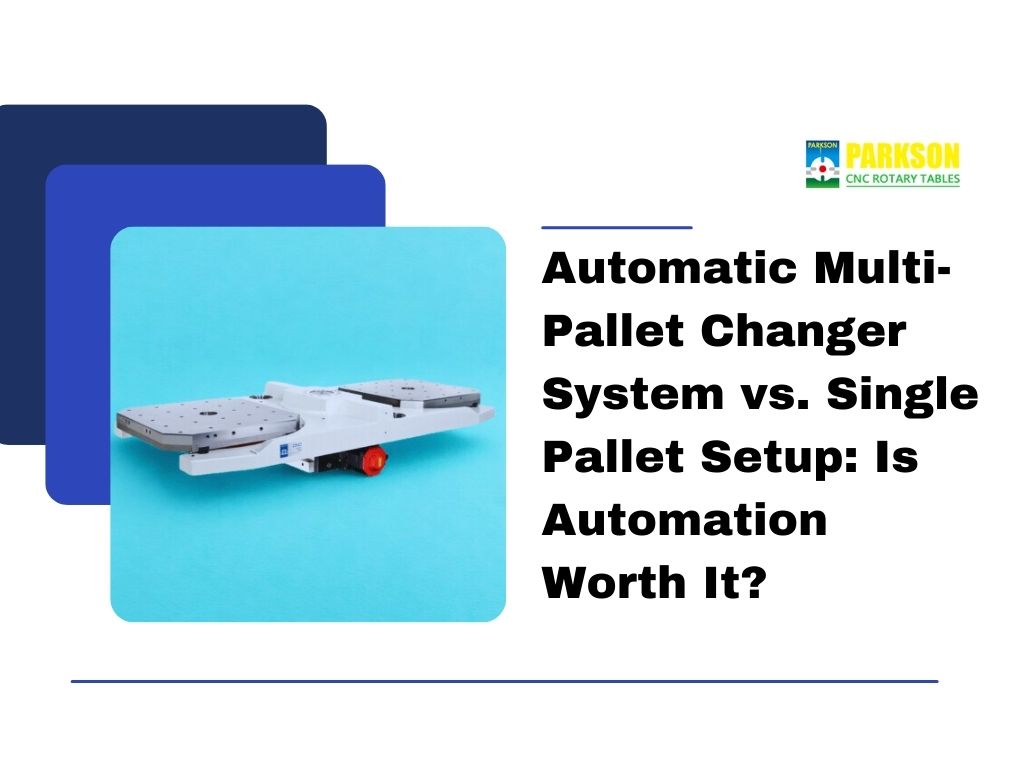
As manufacturers face increasing pressure to shorten lead times, reduce labor dependency, and improve machine utilization, automation has become a critical topic in CNC machining. One of the most frequently asked questions is whether upgrading from a traditional single pallet setup to an automatic multi-pallet changer system is truly worth the investment.
As a Taiwan-based manufacturer specializing in rotary tables and automation-ready machining solutions, PARKSON regularly works with manufacturers evaluating this decision in real production environments. This article compares both approaches from a practical manufacturing perspective, helping decision-makers understand when an automatic multi-pallet changer system delivers measurable value—and when a single pallet setup may still be sufficient.
Understanding the Difference: Single Pallet vs. Automatic Multi-Pallet Changer System
A single pallet setup requires the CNC machine to stop machining whenever parts are loaded, unloaded, or fixtures are changed. While this approach is simple and cost-effective, machine utilization is directly limited by setup time and operator availability.
An automatic multi-pallet changer system allows multiple pallets to be prepared outside the machine while machining continues on another pallet. Pallets are exchanged automatically, enabling continuous or near-continuous operation and significantly reducing idle time.
Productivity Comparison: Where the Biggest Gap Appears
The most noticeable difference between the two setups lies in spindle utilization.
With a single pallet setup:
- Machining stops during every loading and unloading cycle
- Setup time directly reduces productive machining hours
- Unmanned or overnight operation is difficult to achieve
With an automatic multi-pallet changer system:
- Machining and setup can occur simultaneously
- Idle time between cycles is minimized
- Machines can operate unattended for extended periods
For manufacturers handling frequent changeovers or complex workpieces, the productivity gap quickly becomes substantial.
Labor Dependency and Workforce Challenges
Labor availability and cost are growing concerns across global manufacturing.
Single pallet setups:
- Require an operator for each pallet change
- Increase dependence on skilled labor during production
- Limit scalability when workforce availability fluctuates
Automatic multi-pallet changer systems:
- Reduce operator intervention during machining
- Allow one operator to supervise multiple machines
- Support lights-out or low-supervision production
This shift improves production stability while reducing long-term labor pressure.
Flexibility for High-Mix, Low-Volume Production
Many CNC shops today operate under high-mix, low-volume production models.
Single pallet setups:
- Struggle with frequent fixture changes
- Create bottlenecks during short production runs
- Increase the risk of setup errors under time constraints
Automatic multi-pallet changer systems:
- Enable different part types to run in parallel
- Allow fixtures to be prepared offline
- Improve scheduling flexibility without sacrificing efficiency
For job shops and contract manufacturers, this flexibility often becomes a decisive advantage.
Cost Consideration: Investment vs. Long-Term Return
Although single pallet setups have a lower initial cost, they often incur hidden expenses over time.
Single pallet setup:
- Lower upfront investment
- Higher cumulative downtime cost
- Limited expansion and automation potential
Automatic multi-pallet changer system:
- Higher initial investment
- Faster return through improved machine utilization
- Scalable platform for future automation upgrades
When evaluated across the full equipment lifecycle, the multi-pallet system frequently delivers a stronger return on investment.
Integration with Rotary Tables and Multi-Axis Machining
Automation reaches its full potential when combined with advanced positioning systems.
An automatic multi-pallet changer system can be integrated with:
- CNC rotary tables
- Tilting rotary tables for 4-axis and 5-axis machining
- Zero-point clamping systems
- Multi-station or cell-based production layouts
This integration transforms individual machines into flexible manufacturing cells rather than isolated workstations.
Single Pallet vs. Automatic Multi-Pallet Changer System Comparison
The table below summarizes the key differences from a production and operational standpoint.
| Evaluation Item | Single Pallet Setup | Automatic Multi-Pallet Changer System |
|---|---|---|
| Machine Utilization | Limited by setup and loading time | High utilization with continuous machining |
| Setup Efficiency | Setup performed during machine stop | Fixtures prepared offline during machining |
| Labor Dependency | High – operator needed at each changeover | Reduced – one operator can manage multiple machines |
| Production Flexibility | Best for long, stable production runs | Ideal for high-mix, low-volume production |
| Unmanned Operation | Difficult to implement | Suitable for lights-out machining |
| Expansion Capability | Limited scalability | Expandable toward FMS and automation cells |
| Initial Investment | Lower | Higher |
| Long-Term ROI | Lower due to idle time | Higher through productivity gains |
When Does Automation Make Sense?
Upgrading to an automatic multi-pallet changer system is especially worthwhile when:
- Setup time occupies a large portion of total cycle time
- Production involves frequent part or fixture changes
- Unmanned or extended operation is a strategic goal
- Machine utilization is a key performance indicator
- Future expansion toward FMS or smart manufacturing is planned
For stable, long-run production with minimal changeovers, a single pallet setup may still be sufficient. However, as complexity increases, automation quickly becomes a competitive necessity.
Frequently Asked Questions (FAQ)
1. How many pallets are typically used in an automatic multi-pallet changer system?
Common configurations range from 2 to 8 pallets. Larger systems may support more pallets depending on production complexity and unmanned operation requirements.
2. Is a multi-pallet changer suitable for small batch production?
Yes. High-mix, low-volume production often benefits the most, as offline fixture preparation significantly reduces downtime.
3. Does a multi-pallet system require replacing existing CNC machines?
Not necessarily. Many systems are designed to integrate with existing CNC machines, especially when combined with rotary tables or automation-ready configurations.
4. How does pallet positioning accuracy affect machining quality?
High repeatability ensures consistent datum alignment, maintaining machining accuracy across multiple pallets and unattended cycles.
5. Can multi-pallet systems be combined with 4-axis or 5-axis machining?
Yes. They are frequently integrated with rotary tables and tilting rotary tables to form flexible 4-axis and 5-axis machining cells.
6. When should a shop consider upgrading from a single pallet setup?
When setup time becomes a bottleneck, labor availability is limited, or future automation is part of the production strategy.
PARKSON’s Perspective on Automation-Ready Solutions
PARKSON designs automatic multi-pallet changer systems with a focus on rigidity, repeatable positioning accuracy, and system-level integration. Rather than treating pallet changers as standalone accessories, PARKSON emphasizes seamless integration with rotary tables and multi-axis machining solutions.
This system-oriented approach allows manufacturers to transition from manual setups to automated production in a controlled, scalable, and future-ready manner.
Conclusion: Is an Automatic Multi-Pallet Changer System Worth It?
The answer depends on production goals—but for many manufacturers, automation is no longer optional.
Compared to a single pallet setup, an automatic multi-pallet changer system delivers:
- Higher machine utilization
- Reduced labor dependency
- Greater flexibility for complex scheduling
- A solid foundation for smart manufacturing
When evaluated strategically, automation becomes a long-term competitive advantage rather than a simple equipment upgrade.
Upgrade Your Automation Strategy with PARKSON
PARKSON provides automation-ready solutions designed to enhance CNC productivity and support future manufacturing growth. Contact our technical team to discuss how an automatic multi-pallet changer system can fit into your machining environment.