
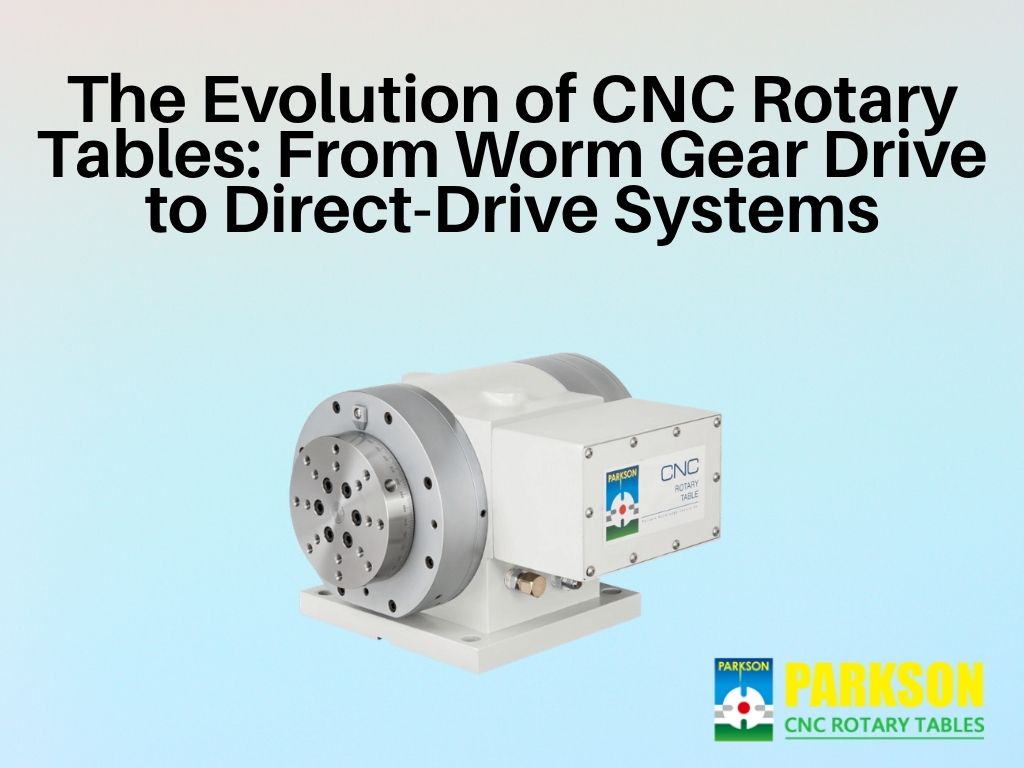
CNC rotary tables have played a critical role in modern machining for decades. From simple indexing applications to advanced simultaneous multi-axis machining, rotary table technology has continuously evolved to meet the growing demands of precision manufacturing.
As industries such as aerospace, medical devices, mold manufacturing, and high-precision engineering push for tighter tolerances and faster machining cycles, the limitations of traditional rotary drive systems have become more apparent. This has led to the development of direct-drive rotary table systems, also known as torque motor rotary tables, which offer significant improvements in speed, precision, and dynamic performance.
This article explores the evolution of CNC rotary tables, comparing traditional worm gear drive systems with modern direct-drive technologies and explaining why direct-drive rotary tables are becoming increasingly important in advanced machining environments.
The Early Role of CNC Rotary Tables
Traditional CNC rotary tables were primarily developed to improve machining flexibility by allowing workpieces to rotate automatically during machining operations.
These systems made it possible to:
- Perform multi-face machining in fewer setups
- Improve positioning accuracy
- Reduce manual workpiece repositioning
- Increase machine utilization
For many years, the most common rotary table mechanism used a worm gear drive system, which became the industry standard due to its durability and relatively simple structure.
How Worm Gear Drive Rotary Tables Work
A worm gear rotary table uses a worm shaft to drive a worm wheel connected to the rotary axis. This mechanical transmission system converts motor rotation into controlled rotary movement.
Worm gear rotary tables became widely adopted because they offer:
- Strong torque transmission
- Reliable clamping capability
- Stable indexing performance
- Cost-effective manufacturing
These characteristics made them suitable for:
- General 4-axis machining
- Heavy-duty cutting applications
- Standard indexing operations
- Conventional CNC machining centers
Even today, worm gear rotary tables remain widely used across many machining industries.
Limitations of Traditional Worm Gear Systems
As machining requirements became more demanding, several limitations of worm gear systems became more noticeable.
Mechanical Backlash
Because worm gears rely on physical gear engagement, a small amount of backlash is unavoidable. Although backlash compensation technologies can reduce the effect, eliminating it entirely is difficult.
This becomes a challenge in:
- Simultaneous multi-axis machining
- High-speed contouring
- Ultra-precision applications
Limited Dynamic Performance
Worm gear systems contain multiple mechanical transmission components, which create inertia and resistance during acceleration and deceleration.
As a result:
- Rotary motion is slower
- Dynamic response is reduced
- Rapid positioning becomes more difficult
This limits machining efficiency in high-speed multi-axis environments.
Increased Maintenance Requirements
Mechanical transmission systems require:
- Lubrication
- Gear inspection
- Wear compensation
- Periodic maintenance
Over time, gear wear can affect long-term positioning accuracy and machine stability.
The Rise of Direct-Drive Rotary Table Technology
To overcome these limitations, manufacturers began developing direct-drive rotary tables, commonly referred to as torque motor rotary tables.
Unlike worm gear systems, a direct-drive rotary table uses a torque motor mounted directly to the rotary axis without intermediate mechanical transmission components.
This design fundamentally changes the performance characteristics of the rotary system.
Key Advantages of Direct-Drive Rotary Tables
Zero Backlash Motion
One of the biggest advantages of a direct-drive rotary table is the elimination of mechanical backlash.
Because there are no gears between the motor and rotary axis:
- Positioning accuracy improves significantly
- Motion becomes smoother
- Simultaneous multi-axis machining becomes more stable
This is especially important in:
- Aerospace machining
- Mold and die production
- Medical component manufacturing
- Optical and semiconductor applications
Higher Speed and Dynamic Response
Direct-drive systems offer much faster acceleration and deceleration compared to worm gear systems.
Benefits include:
- Faster rotary positioning
- Reduced cycle time
- Improved contouring accuracy
- Better synchronization with linear axes
For complex 5-axis machining, this dynamic response is critical.
Improved Surface Finish
Because a direct-drive rotary table produces smoother rotary motion with less vibration, machining stability improves significantly.
This helps achieve:
- Better surface finish quality
- Reduced polishing work
- More stable cutting conditions
- Higher dimensional consistency
These benefits are highly valuable in precision mold and aerospace machining.
Lower Maintenance Requirements
Without mechanical gears, many wear-related maintenance concerns are reduced.
Direct-drive rotary tables typically require:
- Less lubrication
- Fewer mechanical adjustments
- Lower long-term maintenance costs
This improves machine reliability and long-term operational stability.
Worm Gear vs Direct-Drive Rotary Table Comparison
| Feature | Worm Gear Rotary Table | Direct-Drive Rotary Table |
|---|---|---|
| Drive System | Mechanical worm gear transmission | Direct-drive torque motor |
| Backlash | Small mechanical backlash exists | Virtually zero backlash |
| Dynamic Response | Moderate acceleration and deceleration | Very high dynamic response |
| Positioning Speed | Standard rotary positioning speed | High-speed positioning capability |
| Motion Smoothness | Limited by gear engagement | Extremely smooth continuous motion |
| Positioning Accuracy | Good for general machining | Excellent for high-precision machining |
| Maintenance Requirement | Requires lubrication and gear maintenance | Lower maintenance due to fewer mechanical parts |
| Long-Term Wear | Gear wear may affect accuracy over time | Reduced mechanical wear |
| Surface Finish Stability | Good for standard machining | Excellent for high-speed contour machining |
| Best Application | Heavy-duty indexing and general machining | High-speed 4-axis and 5-axis machining |
| Typical Industries | General manufacturing, heavy cutting | Aerospace, medical, mold & die, precision machining |
| Initial Investment | Lower | Higher |
| Long-Term Productivity | Stable for conventional operations | Higher efficiency for advanced machining environments |
Both systems remain important depending on machining requirements. Worm gear systems continue to perform well in heavy-duty indexing applications, while direct-drive systems excel in high-speed, high-precision machining environments.
PARKSON’s Rotary Table Technology Solutions
PARKSON WU INDUSTRIAL CO., LTD. is a Taiwan-based manufacturer specializing in CNC rotary tables and multi-axis positioning solutions for advanced machining applications. PARKSON offers a wide range of rotary table products, including traditional worm gear rotary tables and direct-drive high-speed rotary tables designed for precision 4-axis and 5-axis machining environments.
PARKSON’s rotary table solutions support various machining requirements, including multi-face machining, simultaneous multi-axis contouring, and high-speed precision machining. The product lineup includes both conventional rotary table systems for stable heavy-duty machining and direct-drive rotary tables for applications requiring high dynamic response and zero-backlash motion.
Key engineering features include:
- High-rigidity structural design
- Precision rotary axis control
- Direct-drive torque motor technology
- High-resolution encoder options
- Compatibility with major CNC control systems
These solutions help manufacturers improve machining precision, increase productivity, and support modern multi-axis machining operations.
Frequently Asked Questions (FAQ)
1. Are worm gear rotary tables still widely used?
Yes. Worm gear rotary tables remain common in many machining applications, especially for heavy-duty indexing and general machining operations.
2. What is the biggest advantage of a direct-drive rotary table?
The biggest advantage is zero-backlash direct-drive motion, which improves positioning accuracy and dynamic performance.
3. Are direct-drive rotary tables better for 5-axis machining?
Yes. Their smooth motion and fast dynamic response make them highly suitable for simultaneous 5-axis machining.
4. Do direct-drive rotary tables require less maintenance?
Generally yes. Because they eliminate mechanical gear systems, maintenance requirements are reduced.
5. Which industries benefit most from direct-drive rotary tables?
Industries such as aerospace, mold manufacturing, medical devices, semiconductor machining, and precision engineering benefit significantly from direct-drive technology.
Conclusion
The evolution of CNC rotary tables reflects the broader transformation of modern manufacturing. While traditional worm gear rotary tables continue to provide reliable performance in many machining applications, direct-drive systems have introduced a new level of precision, speed, and motion control.
As machining demands continue to increase, the direct-drive rotary table is becoming an essential solution for advanced multi-axis manufacturing environments.
For manufacturers seeking higher productivity, better surface quality, and long-term machining accuracy, understanding the differences between worm gear and direct-drive systems is critical when selecting the right rotary table technology.
Upgrade Your Multi-Axis Machining Capability with PARKSON
PARKSON provides advanced rotary table solutions designed for modern CNC machining environments, including both traditional worm gear rotary tables and high-speed direct-drive systems. Contact our technical team to learn more about selecting the right rotary table solution for your application.