
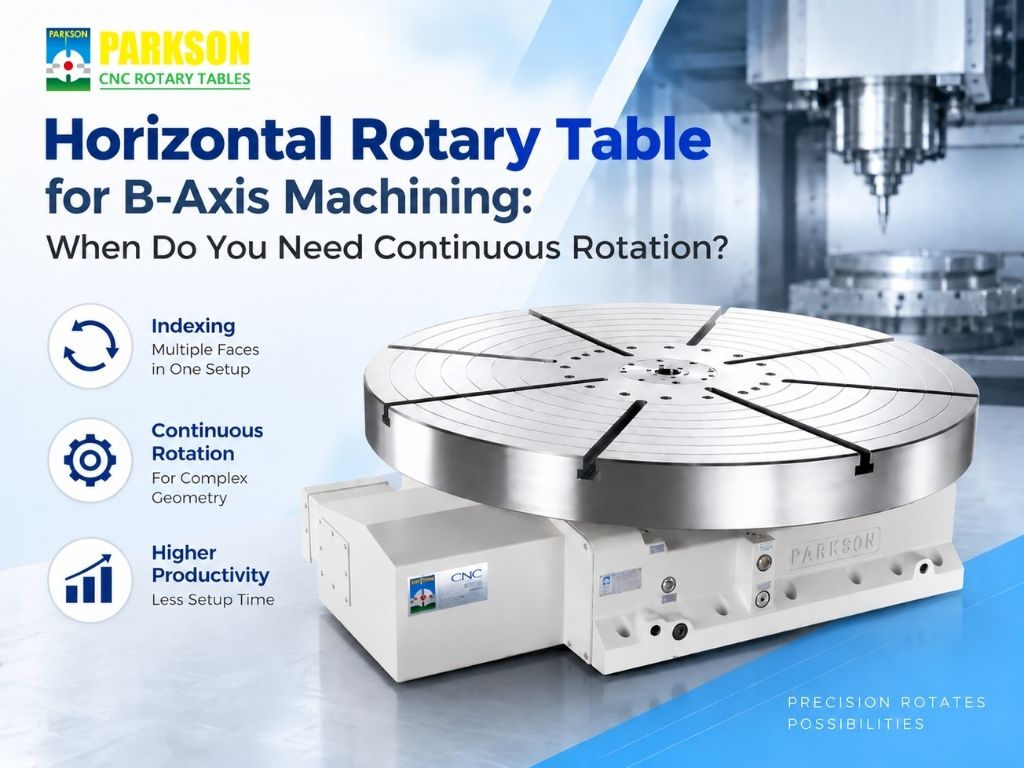
When selecting a horizontal rotary table for a CNC machine, one of the most important questions is not simply table size or load capacity. Manufacturers also need to determine how the B-axis will actually be used during machining.
Does the workpiece only need to rotate to several fixed angles before cutting begins again? Or does the rotary axis need to move continuously while the X, Y, and Z axes are machining?
These are very different requirements.
For many prismatic components, positioning the workpiece at 90°, 180°, or another programmed angle may be sufficient. More complex parts, however, may require coordinated rotary movement during cutting to machine curved surfaces, complex contours, or features that cannot be efficiently produced through fixed-angle positioning alone.
Understanding the difference between B-axis indexing and continuous rotation is therefore an important step when selecting a horizontal rotary table.
Table of Contents
- What Does the B-Axis Do on a Horizontal Rotary Table?
- B-Axis Indexing vs. Continuous Rotation: What Is the Difference?
- When Is B-Axis Indexing Enough?
- When Do You Actually Need Continuous B-Axis Rotation?
- Why One-Setup Machining Matters
- Continuous Rotation Is Not the Only Specification That Matters
- Do Heavy-Duty Workpieces Always Need Continuous Rotation?
- How to Decide Which B-Axis Capability Your Machine Needs
- PARKSON Horizontal CNC Rotary Table Solutions
- FAQ: Horizontal Rotary Table for B-Axis Machining
What Does the B-Axis Do on a Horizontal Rotary Table?
On a horizontal machining setup, the B-axis provides controlled rotary positioning of the workpiece. Instead of repeatedly removing and reclamping the part to reach different machining faces, the rotary table changes the workpiece orientation according to the CNC program.
PARKSON's Horizontal CNC Rotary Table range supports equal, unequal, and continuous rotary machining, allowing the B-axis to serve different machining strategies depending on the machine configuration and production requirements.
For example, a workpiece may only need to rotate between several fixed positions for drilling, milling, or boring on multiple sides. In another application, the B-axis may need to rotate together with the machine's linear axes throughout the cutting operation.
This leads to an important distinction:
B-axis positioning tells the machine where to place the workpiece. Continuous B-axis machining allows rotary movement to become part of the cutting path itself.
The second requirement generally becomes more relevant as part geometry and machining complexity increase.
B-Axis Indexing vs. Continuous Rotation: What Is the Difference?
The easiest way to understand the difference is to look at what the rotary table does while the tool is cutting.
With conventional indexing, the table rotates to a programmed angular position and stops. After the axis reaches and secures the required position, machining takes place. The table can then move to another angle for the next operation.
With continuous B-axis machining, rotary motion can participate in the machining process together with the machine's linear axes.
| Machining Requirement | B-Axis Indexing | Continuous B-Axis Rotation |
|---|---|---|
| Rotary movement | Moves between programmed positions | Can move during machining |
| Typical positioning | Fixed angles | Continuously changing angles |
| Multi-face machining | Yes | Yes |
| Complex contour machining | Limited by fixed positions | Better suited to coordinated contour machining |
| CNC coordination | Position, machine, reposition | Rotary and linear axes can work together |
| Typical workpiece need | Multiple accessible faces | Complex geometry or surfaces |
| Selection priority | Positioning and clamping | Positioning plus coordinated rotary motion |
Neither approach is automatically better.
The correct choice depends on whether the geometry of the part actually requires rotary movement during the cutting process.
When Is B-Axis Indexing Enough?
For a large percentage of horizontal machining applications, continuous rotation may not be necessary.
Consider a gearbox housing that requires boring, drilling, and milling on four different sides. If each feature can be accessed by rotating the workpiece to a fixed angle, machining can follow a straightforward sequence:
Machine the first face → rotate the table → lock at the next position → machine the second face → repeat.
The main advantage is that several sides of the component can be completed without repeatedly removing and reclamping the workpiece.
This can be especially valuable for large or difficult-to-handle components, where every additional setup introduces time and another opportunity for positioning variation.
In these situations, the purchasing decision should focus heavily on factors such as table dimensions, workpiece and fixture load, rigidity, positioning requirements, clamping method, and machine compatibility rather than specifying continuous machining simply because the capability is available.
If your main goal is to reduce manual repositioning and machine multiple faces in fewer setups, you may also want to read When Do You Really Need a 4th Axis Rotary Table? A Practical Guide for CNC Shops .
When Do You Actually Need Continuous B-Axis Rotation?
Continuous B-axis capability becomes important when fixed angular positioning cannot efficiently generate the required geometry.
This is most relevant when the tool needs to maintain a changing relationship with the workpiece throughout the cutting path. Instead of rotating to an angle and stopping, the rotary axis becomes an active part of the programmed machining motion.
PARKSON's HMC Series, for example, is designed to work with the machine's X/Y/Z axes for simultaneous machining and can support applications involving curved surfaces and other complicated workpieces.
Typical situations where continuous rotary machining may be worth considering include:
- Curved or contoured surfaces
- Complex workpiece geometry
- Features located across continuously changing angles
- Machining strategies requiring coordinated linear and rotary motion
- Parts where multiple conventional setups would otherwise be necessary
The key question is therefore not “Do I want a more advanced rotary table?”
It is:
“Does my toolpath require the B-axis to move while material is being removed?”
If the answer is yes, continuous rotary capability becomes an important selection requirement.
Why One-Setup Machining Matters
Whether the B-axis is used for indexing or continuous machining, one of the major reasons for adding a horizontal rotary table is the ability to reach more surfaces of a workpiece under one setup.
Every time a component is removed, repositioned, aligned, and clamped again, additional non-cutting time is introduced. Multiple setups can also create another source of variation because the workpiece reference must be re-established.
A properly integrated horizontal rotary table allows the CNC machine to change workpiece orientation instead.
PARKSON's HMC Series can perform multi-surface machining under one setup, helping reduce loading and unloading operations while reducing machining errors that may result from repeated workholding.
For manufacturers evaluating a B-axis system, this is an important point: the value of the rotary table should be measured by how it simplifies the entire machining process—not merely by how accurately it rotates.
Continuous Rotation Is Not the Only Specification That Matters
It can be tempting to make continuous B-axis capability the main selection criterion, especially when evaluating more complex machining applications. In practice, the rotary table still needs to perform reliably under the actual cutting conditions.
A large workpiece creates axial, radial, and overturning forces on the rotary table. Fixture weight must also be considered because the table supports the complete machining load—not only the finished component.
Rigidity is equally important. A rotary table may provide the required movement, but the complete system must remain stable while the cutting tool generates machining forces.
For example, PARKSON's HMC-801 and HMC-1000 specify a bearing structure designed to withstand axial, radial, and overturning loads. Both models are intended for horizontal boring and milling machines and support synchronous cutting and processing.
This means B-axis selection should consider motion requirement, workpiece size, fixture load, cutting conditions, table structure, and machine integration together.
For applications involving large workpieces or demanding cutting conditions, rotary motion is only part of the selection process. Read Choosing the Right CNC Rotary Table for Heavy-Duty Machining Applications for a closer look at load capacity, rigidity, transmission systems, and other heavy-duty selection factors.
Do Heavy-Duty Workpieces Always Need Continuous Rotation?
No. Heavy-duty machining and continuous B-axis machining should not be treated as the same requirement.
A very large component may require substantial table size, load support, strong locking, and structural rigidity but only need a few fixed machining positions. In that situation, a heavy-duty positioning solution may be more important than continuous rotation.
PARKSON's HMD Series illustrates this distinction. The HMD-2500, for example, uses a large bevel gear and double-gear transmission, hydraulic locking, and a 90-degree positioning pin arrangement intended to withstand heavy cutting. Its product information describes asynchronous cutting and processing rather than the synchronous machining described for HMC models.
This is why manufacturers should avoid selecting a horizontal rotary table from a single specification.
A better starting point is to define the machining process first:
What needs to rotate? How heavy is it? At which angles? Does the axis move during cutting? What cutting forces will the system experience?
Those answers narrow the appropriate table configuration much more effectively.
How to Decide Which B-Axis Capability Your Machine Needs
Before requesting a horizontal rotary table, manufacturers can divide their requirements into three practical levels.
Level 1: Fixed-Angle Positioning
Choose this approach when the main objective is to access multiple faces by rotating the workpiece between predetermined angles.
The table positions the workpiece, stops, and machining takes place.
Level 2: Flexible Angular Positioning
This becomes useful when parts require many different programmed angles rather than only standard positions such as 90° or 180°.
The B-axis provides greater positioning flexibility, but cutting can still primarily occur after the required position has been reached.
Level 3: Continuous B-Axis Machining
This is appropriate when the rotary axis needs to participate directly in the machining path with X/Y/Z movement.
It is the requirement most closely associated with curved surfaces, complex contours, and other geometries that cannot be efficiently handled through fixed-angle indexing alone.
Defining which of these three levels describes your actual process can prevent both under-specifying the rotary axis and paying for capabilities that the application does not need.
If your application requires high-speed rotary motion or more advanced simultaneous machining, the drive system becomes another important consideration. Read The Evolution of CNC Rotary Tables: From Worm Gear Drive to Direct-Drive Systems to understand how the two technologies differ.
PARKSON Horizontal CNC Rotary Table Solutions
PARKSON offers several Horizontal CNC Rotary Table configurations for different machining requirements, including the HMC Series, HMD Series, HMG3 Series, FMH(B) 2-Pallet Series, and FMHG 2-Pallet Series.
The HMC Series covers different table sizes for a broad range of horizontal machining requirements and supports positioning machining as well as coordinated machining with other CNC axes.
Other PARKSON horizontal rotary table configurations address different production priorities, including heavy-duty positioning and two-pallet arrangements.
Rather than selecting by table size alone, manufacturers should provide information about the machine type, workpiece dimensions, fixture weight, machining load, required B-axis movement, positioning requirements, and whether simultaneous machining is necessary.
This makes it easier to identify a horizontal rotary table configuration that matches the actual machining process.
Explore PARKSON Horizontal CNC Rotary Tables
FAQ: Horizontal Rotary Table for B-Axis Machining
When should I choose continuous B-axis machining?
Continuous B-axis machining should be considered when the required toolpath cannot be efficiently completed through fixed-angle indexing alone. This is particularly relevant for curved surfaces, complex contours, or features where the workpiece orientation must change continuously while the linear axes are machining.
Before specifying continuous rotation, manufacturers should review the actual part geometry and CNC toolpath to determine whether rotary movement is required during cutting or only between machining operations.
Is continuous B-axis rotation necessary for large or heavy workpieces?
Not necessarily. Workpiece size and weight do not automatically determine whether continuous rotation is required.
A large or heavy component may only need to be positioned at several fixed angles for boring, milling, or drilling. In this case, load capacity, table rigidity, locking capability, bearing structure, and resistance to machining forces may be more important selection factors than continuous rotary motion.
Continuous B-axis capability should be selected based on the machining path rather than workpiece weight alone.
What information should I provide when selecting a horizontal rotary table?
To select an appropriate horizontal rotary table, manufacturers should provide more than the required table size. Important information includes the CNC machine type, workpiece dimensions and weight, fixture dimensions and weight, required machining angles, cutting conditions, positioning requirements, and expected B-axis movement.
Most importantly, specify whether the B-axis only needs to reposition the workpiece between operations or must move continuously during machining. This distinction helps determine whether a positioning-oriented or continuous B-axis solution is more appropriate.
Related Articles
When Do You Really Need a 4th Axis Rotary Table? A Practical Guide for CNC Shops
Learn when adding a rotary axis can reduce manual repositioning, simplify multi-face machining, and improve CNC machine utilization.
Choosing the Right CNC Rotary Table for Heavy-Duty Machining Applications
Explore the key factors to consider when rotary table load capacity, rigidity, cutting forces, and machining stability become critical.
The Evolution of CNC Rotary Tables: From Worm Gear Drive to Direct-Drive Systems
Compare traditional worm gear and direct-drive rotary table technologies to determine which drive system better matches your machining requirements.
Choose the B-Axis Based on the Machining Process
A horizontal rotary table should not be selected simply because one model offers more advanced rotary capability than another.
For straightforward multi-face machining, B-axis indexing may provide exactly what the process requires. When workpiece geometry demands coordinated rotary movement during cutting, continuous B-axis machining becomes much more important.
The best approach is therefore to begin with the part and toolpath rather than the rotary table specification sheet.
Determine which surfaces must be machined, how the workpiece must move to reach them, whether cutting occurs during rotation, and what loads the table must support. From there, the required B-axis configuration becomes much clearer.
Looking for the Right Horizontal Rotary Table?
PARKSON provides horizontal CNC rotary table solutions for different B-axis positioning, machining, workpiece size, and production requirements.
If you are unsure whether your application requires fixed positioning or continuous B-axis machining, provide your machine and workpiece requirements to PARKSON for further evaluation.