

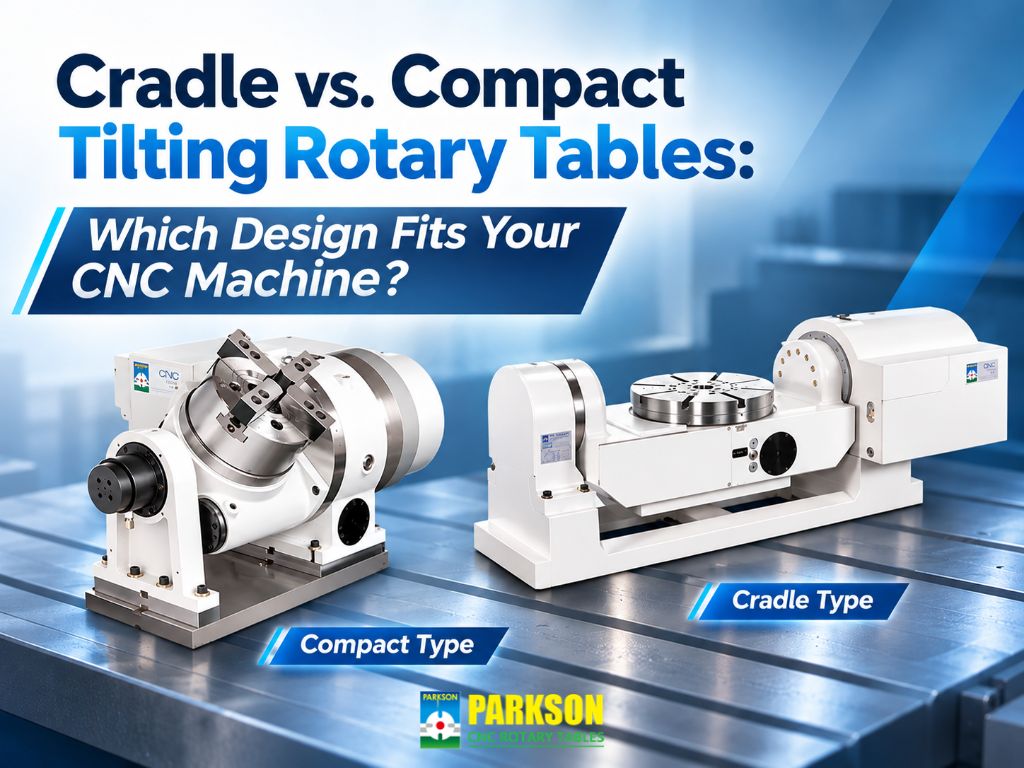
Choosing a CNC tilting rotary table is not simply about selecting the right table diameter. The structural design also affects installation space, workpiece support, tool accessibility, and the machining angles available within a CNC machine.
Two configurations worth comparing are cradle-type and compact-type CNC tilting rotary tables. Both provide rotary and tilting motion for multi-axis machining, but their mechanical arrangements and installation requirements differ.
For manufacturers upgrading a vertical machining center or planning a five-axis machining setup, understanding these differences can help prevent clearance problems, unsuitable workholding arrangements, and unnecessary equipment costs.
This guide compares both designs and explains how to select the right configuration for your CNC machine.
1. What Is the Difference Between Cradle and Compact Tilting Rotary Tables?
The main difference between cradle-type and compact-type CNC tilting rotary tables is the mechanical arrangement used to support and tilt the rotating platform.
Cradle-Type Tilting Rotary Table
A cradle-type tilting rotary table uses a cradle-style structure to support the rotating platform through a tilting assembly. This configuration is worth considering when workpiece support, tilting geometry, and machining stability are important selection factors.
However, the suitability of a cradle-type structure depends on the workpiece dimensions, center of gravity, cutting forces, and available machine space.
Compact-Type Tilting Rotary Table
A compact tilting rotary table uses a more space-conscious mechanical arrangement. It is worth evaluating when the available machining area is limited or when the application involves relatively small workpieces.
A compact configuration may simplify installation within certain machining centers, but the complete motion envelope must still be checked.
Key takeaway: Compact does not automatically mean less accurate, and cradle-type does not automatically mean higher load capacity. Actual performance depends on the selected model, drive system, bearings, clamping arrangement, and manufacturer specifications.
For additional information about selecting a suitable configuration, read Choosing the Right Tilting Rotary Table for Your CNC Machine: Size, Torque & Compatibility Guide.
2. Cradle vs. Compact Tilting Rotary Table: Quick Comparison
The following comparison highlights the main factors manufacturers should evaluate before selecting a CNC tilting rotary table.
| Selection Factor | Cradle Type | Compact Type |
|---|---|---|
| Structural Design | Cradle-supported tilting arrangement | Space-conscious tilting arrangement |
| Installation Space | Requires evaluation of the complete cradle assembly and movement envelope | Worth considering when machine space is limited |
| Workpiece Size | Available in configurations for different workpiece sizes | Often considered for smaller machining setups |
| Cutting Stability | Depends on structural support, clamping, and model specifications | Depends on structural support, clamping, and model specifications |
| Tool Accessibility | Check cradle structure, fixtures, and tool interference | Check machine clearance, body dimensions, and tilt-position interference |
| Selection Priority | Evaluate workpiece support and machining envelope | Evaluate installation dimensions and machine clearance |
Key takeaway: Neither configuration is universally better. The correct choice is the one that supports the required workpiece, machining angles, cutting loads, and machine travel without interference.
3. When Should You Choose a Cradle-Type Tilting Rotary Table?
A cradle-type design is worth evaluating when the machining application requires a tilting platform supported by a cradle-style structure.
Manufacturers may consider this configuration in the following situations:
- Larger or more complex workpieces: The workpiece and fixture require a suitable supporting structure during multi-angle machining.
- Multi-face machining: The component must be repositioned through different angles without repeated manual clamping.
- Demanding cutting operations: Tilting-axis rigidity, braking capacity, and resistance to cutting forces must be evaluated.
- Dedicated five-axis configurations: The machine layout can accommodate the cradle assembly and its complete movement envelope.
Before choosing a cradle-type rotary table, manufacturers should confirm the workpiece center of gravity, allowable load, tilting torque, clamping capacity, and available machine travel.
PARKSON PARS Series Cradle Type CNC Tilting Rotary Table
PARKSON offers the PARS Series Cradle Type CNC Tilting Rotary Table, including PARS-252, PARS-300, PARS-350, PARS-400, PARS-503, PARS-631, and PARS-800 models.
These models provide different options for manufacturers evaluating cradle-type tilting configurations. The final selection should be based on the individual model's specifications and the intended machining conditions.
4. When Is a Compact Tilting Rotary Table the Better Option?
A compact tilting rotary table is worth considering when installation space is a major constraint.
For example, a manufacturer upgrading an existing vertical machining center may have sufficient machining capability but limited space between the spindle, machine table, enclosure, and workpiece.
A compact configuration may help simplify the layout, provided that its actual dimensions and motion envelope fit the machine.
Applications Where a Compact Design May Be Suitable
- The available machine-table area is limited.
- The workpieces and fixtures are relatively small.
- The manufacturer wants to add rotary and tilting functions to an existing machining center.
- Spindle-to-workpiece clearance must be carefully managed.
- The required machining load falls within the selected model's rated capacity.
PARKSON DMTRT Series Compact Type CNC Tilting Rotary Table
PARKSON's DMTRT Series Compact Type CNC Tilting Rotary Table includes DMTRT-171L, DMTRT-221L, DMTRT-280L, and DMTRT-320L models.
For example, the DMTRT-171L features a 170 mm table diameter, adjustable preload, a wear-resistant alloy-copper worm wheel, an alloy-steel worm shaft, and a bearing structure designed to withstand axial, radial, and overturning loads.
These specifications illustrate why manufacturers should review each model individually instead of assuming that a compact design has lower rigidity or accuracy.
Selection tip: Compare the rotary table's actual dimensions, workpiece capacity, and tilting range with the available machine workspace before purchasing.
For another practical application of tilting rotary tables, read How a Tilting Rotary Table Improves Mold and Die Machining Efficiency.
5. Five Factors to Check Before Selecting a Tilting Rotary Table
Whether you are considering a cradle-type or compact-type design, the following five factors should be evaluated before purchasing.
5.1 Available Machine Space
Measure the machine-table dimensions, spindle clearance, enclosure limits, and available axis travel.
The assessment must include the rotary table, workpiece, fixture, and the space they occupy throughout the full tilting motion, not just the unit's stationary dimensions.
5.2 Workpiece Weight and Center of Gravity
Workpiece weight alone is not sufficient for selection.
A fixture or workpiece positioned far from the tilting axis can create a significant overturning moment. Manufacturers should therefore evaluate the combined weight, center-of-gravity position, and expected cutting forces.
5.3 Cutting Forces and Clamping Requirements
The rotary table must maintain stable positioning during machining.
Check the manufacturer's specifications for allowable loads, tilting-axis holding capacity, and appropriate machining conditions.
A larger structure does not automatically guarantee better performance without suitable load and clamping ratings.
5.4 Tool Accessibility and Interference
A rotary table may physically fit inside a CNC machine but still restrict access to certain machining angles.
Before purchasing, verify the tool, spindle, fixture, workpiece, and rotary-table geometry across the required toolpaths.
A CAD-based interference review can help identify potential collisions before installation.
5.5 CNC Control and Axis Integration
Confirm that the CNC controller supports the intended rotary-axis configuration.
Other considerations include servo motor compatibility, feedback devices, drive requirements, cabling, and whether the machining process requires indexed positioning or simultaneous multi-axis motion.
Selection tip: Prepare a drawing showing the machine workspace, rotary-table mounting position, fixture, and maximum workpiece envelope. This gives the rotary-table manufacturer a more reliable basis for recommending a model.
6. Which PARKSON Tilting Rotary Table Series Should You Consider?
PARKSON provides CNC rotary table solutions for manufacturers planning multi-axis machining, machine-tool upgrades, and different workpiece configurations.
For manufacturers comparing cradle and compact structures, the following product families are the most relevant starting points.
PARS Series – Cradle Type CNC Tilting Rotary Table
The PARS Series is the product family to evaluate when a cradle-style tilting arrangement is required.
Selection should be based on workpiece size, machining forces, machine clearance, and model-specific specifications.
DMTRT Series – Compact Type CNC Tilting Rotary Table
The DMTRT Series is the product family to evaluate when a more compact tilting arrangement is preferred.
Its suitability depends on actual installation dimensions, load ratings, machining angles, and integration requirements.
Compare PARKSON Tilting Rotary Table Options
Manufacturers can explore PARKSON's broader CNC Tilting Rotary Table product range to compare available configurations.
If you are unsure which design fits your machining center, contact PARKSON with your machine model, workpiece dimensions, required machining angles, and expected cutting conditions.
7. Frequently Asked Questions
Q1. Is a cradle-type tilting rotary table more accurate than a compact type?
Not necessarily. Positioning accuracy depends on the transmission system, bearings, feedback control, assembly, calibration, and operating conditions. Compare published model specifications rather than assuming one structural design is more accurate.
Q2. Can a compact tilting rotary table support five-axis machining?
A compact tilting rotary table can provide rotary and tilting axes for a suitable five-axis configuration. However, simultaneous five-axis machining also requires compatible CNC control, drives, feedback, and machine integration.
Q3. How can I check whether a tilting rotary table will fit my CNC machine?
Compare the machine's available workspace with the complete rotary-table assembly, including fixtures and workpieces. Check the full tilting and rotary motion envelope, spindle clearance, mounting requirements, and axis compatibility.
8. Conclusion: Choose the Design That Matches Your Machining Conditions
The decision between a cradle-type and a compact tilting rotary table should begin with the machining application, not simply the physical appearance of the equipment.
A cradle-type design may be appropriate when the machining layout calls for a cradle-supported platform. A compact design may be preferable when machine space is limited and the required workpiece and cutting conditions fall within the unit's specifications.
In both cases, the most important factors are machine clearance, workpiece loading, cutting stability, tool accessibility, and CNC integration.
Find the Right CNC Tilting Rotary Table with PARKSON
PARKSON provides CNC rotary table solutions for manufacturers planning multi-axis machining and machine-tool upgrades.
Whether you are evaluating the PARS Cradle Type or DMTRT Compact Type series, our team can help review your machining requirements and identify suitable product configurations.
Explore our CNC Tilting Rotary Tables or contact PARKSON to discuss your application.